A little while ago the County Commissioners put up these signs throughout central St. Mary’s County, in medians where panhandlers have been asking motorists for money:
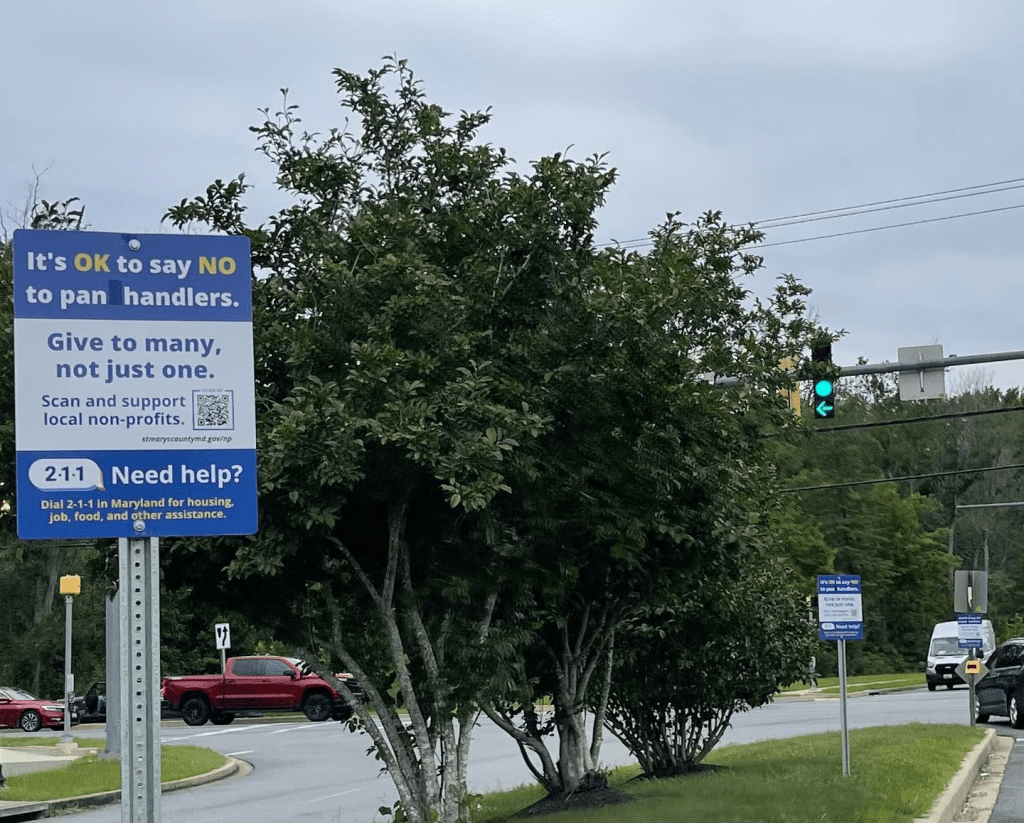
Every sentence of these signs not only reveals the cruelty of our County government but highlights capitalism’s inability to solve poverty.
Aside from the hilariously dehumanizing implication that devious, manipulative panhandlers are guilting innocent passerby to such an extent that they need a sign to reassure their conscience and give them courage – not to mention the further dehumanizing idea that panhandlers represent some sort of blight to be removed – there is the complete uselessness of the rest of the message.
Our response is not only to these signs, but to the system and ideology that produced them.
Charity cannot solve poverty.
The QR code provided by the sign will bring you to a list of every nonprofit based in St. Mary’s County, and some that are broader regional nonprofits. Only a few of them have anything to do with addressing homelessness or poverty. The rest are an assortment of everything from fraternal organizations to orchestras – none of which are of use to unhoused people, or people in poverty. But even those that address poverty and homelessness have their significant limits.
Take the shelters, for instance. Years ago I met a man panhandling who needed money for a motel. He was homeless and caring for his daughter. They could not go to a shelter because his daughter would not be allowed into Three Oaks, but he would not be allowed into the women’s shelter with his daughter. A motel was the only option – other than a tent – that did not separate him from his daughter. Additionally, Three Oaks is criminally underfunded by the county commissioners, and has to turn people away every night due to limited capacity.
The WARM program is a good option for the cold months, but does not operate year-round, and also suffers from limited capacity and low-volunteer turnout. It also moves from church to church, forcing those who utilize it to move around the county.
Feed St. Mary’s and St. Mary’s Caring are great resources for food but are several miles away from the shelters, and our underfunded public transportation makes even going from one end of Great Mills Road to the other a significantly inconvenient ordeal. The rest are so small and underfunded as to be of use to very few people, or they are in another county entirely.
This would seem to support the message of the signs – after all, if these things were better funded wouldn’t they be able to better serve people? It’s true that they would, but their limitations would still exist. To the average unhoused person, or person in poverty, trekking back and forth across the county to benefit from these various services is a time-and-energy-consuming ordeal. Insisting that these folks rely on these services is chaining them to specific routes, locations, and times. It is forcing them to plan their entire life around going back and forth between them.
Cash in hand, however, is independence. Giving somebody actual money allows them to get food from the nearby grocery store instead of taking the bus to the food bank. It allows them to find, or save up for, lodging they can share with their family. It provides them something to save away for a rainy day, or for a phone they can use to apply for jobs. It frees them from being shackled to the locations and opening hours of half a dozen nonprofits.
Giving money directly to people who need it is more efficient than giving to charity.
All of this demonstrates that charity cannot solve poverty, only mitigate it. It does not heal the wound; it only controls the bleeding. This is because poverty and homelessness are not incidental problems, but systemic ones.
Poverty is profitable.
Poverty and homelessness are the result of a system that creates poverty for profit. Consider housing: since the pandemic, rent in St. Mary’s County has increased by more than 8% as a low-end estimate[1], leading to record profits for landlords and realtors. Meanwhile, According to the United Way of Central Maryland “34,000 households will likely face eviction next year, and 17,000 of those are preventable,” and roughly 4420 individuals will become homeless as a result.[2]
Every time rent increases – making housing more unaffordable – it is done to further the profits of landlords. Every time someone is evicted – leading to increased homelessness – it is done to save the profits of landlords. Housing under capitalism is not a public good, or a human right, but a commodity that exists solely for the profit of a few people. There are currently 42 vacant homes for every one homeless person in the state of Maryland[3][4]. Those homes are staying vacant, and those people are on the streets, because it is simply more profitable to create artificial scarcity and drive up the cost of housing than it is to house people. That is all.
The same principle applies to food. In the United States alone, grocery stores and distributors throw away 120 billion pounds of food per year. Roughly 40% of the country’s food supply goes bad sitting on shelves because nobody is buying it[5]. Meanwhile 20,500 people in the United States died of malnutrition in 2022[6], meaning that for every person who died from lack of access to food, there were 5.8 million pounds of food going uneaten. Food under capitalism does not exist to be eaten, it exists to make a profit. And letting people starve is more profitable than giving away food.
These examples, brought to their logical conclusions, further demonstrate why charity can never solve poverty and homelessness under capitalism. Imagine if a well-funded charity were able to distribute all 5.8 billion pounds of wasted food to hungry people before it goes bad – billions of pounds of food given away for free. It would drive down food prices and put grocery stores and distributors out of business. If a charity could put each homeless person in the state of Maryland into one of our state’s 226,875 vacant homes it would similarly drive down the cost of housing and hurt the profits of landlords and realtors. The owners of capital need scarcity – they cannot profit if everyone is getting what they need.
Capitalism needs a permanent underclass.
One of the market forces which defines capitalism is supply and demand. The capitalist needs supply to be low enough compared to demand that they can charge a profitable price. If everyone is getting what they need – in terms of food, shelter, and medicine – then demand for those things is low, and supply is high. The capitalist can no longer profit. They need at least a few people to be starving, homeless, and sick, so that food, shelter, and medicine are in demand.
Moreover, they need people to be unemployed in order to keep wages down. Unemployed people represent a Reserve Army of Labor. When more people are looking for jobs, workers themselves are more replaceable – if workers strike, companies can easily hire scabs. The more replaceable workers are, the more afraid they are of asking for higher wages. The more desperate people are for employment, the more the capitalist can get away with offering low starting salaries. The less capitalists pay workers, the more they profit. If a charity somehow found employment for every person who wanted a job, capitalists would have no leverage over workers, and would have to give in to their every demand for higher wages and better benefits.
People admit every day that capitalism requires a permanent underclass. When they claim, for instance, that paying food-service workers a living wage would drive up the cost of living, they are essentially admitting that capitalism NEEDS certain people to be in poverty to keep prices stable for the rest of us.
Capitalism will never allow charities to solve poverty and homelessness, because it needs those things to continue in order to keep the system running.
The solution to poverty is liberation.
Poverty and homelessness can never be solved under capitalism – especially not through charity. As long as food, shelter, and medicine are considered for-profit commodities instead of human rights, people will be homeless, people will starve, and people will die of preventable diseases. As long as the means of production are privately owned for the profit of a few capitalists, the things we need to survive will remain commodities withheld from us for a price.
Poverty and homelessness is not simply a problem to be solved, but an oppression from which we need to be liberated. This liberation comes from the working class – as a collective – taking control of the means of production. The production and distribution of food, clothing, and shelter needs to be democratically controlled by the people, for the people. Only then – under democratic socialism – can everyone get the food, shelter, and medicine they need.
Until that time – in addition to directly supporting individuals in poverty – we need to work to take political power away from capitalists and landlords and give it to the people. We need to affect structural changes that undermine the institutions that keep us homeless and poor. This means fighting for strong tenants’ unions, strong labor unions, social housing, universal healthcare, living wages, extensive public transportation, and more, as part of the wider fight for true democratic control of the economy.
Until those gains are won, here are just a few of the things the Southern Maryland DSA believes would alleviate homelessness in our community:
- State-level Medicare for All
- Increase funding for public libraries and expand operating hours
- Increase the state corporate tax rate from 8.5% to 15%
- Implement a program of financial reparations to the descendants of people who were enslaved in Maryland
- Rent control
- Implement an Inclusionary Zoning ordinance requiring that a certain percentage of new units are affordable to those making below the median income
- Ban discrimination based on income source (i.e vouchers)
- Ban homeless sweeps
- Reabsorb the St. Mary’s County Housing Authority into the Office of Economic Development and significantly increase its funding
- $25/hour minimum wage
- Unionize all county employees
- Pass the Maryland Fair Scheduling Act
- Stronger protections for collective bargaining
- Statewide Green New Deal / Green Jobs Program
- Reduce dependence on the Department of Defense for employment opportunities
- Increased funding for county buses and quadruple frequency of routes
- Expand MARC to Lexington Park
- Expand the Metro Green Line to La Plata
- Create bus system for workers on NAS Pax River to reduce traffic in Lexington Park, Great Mills, and California
- Increase funding to harm reduction programs
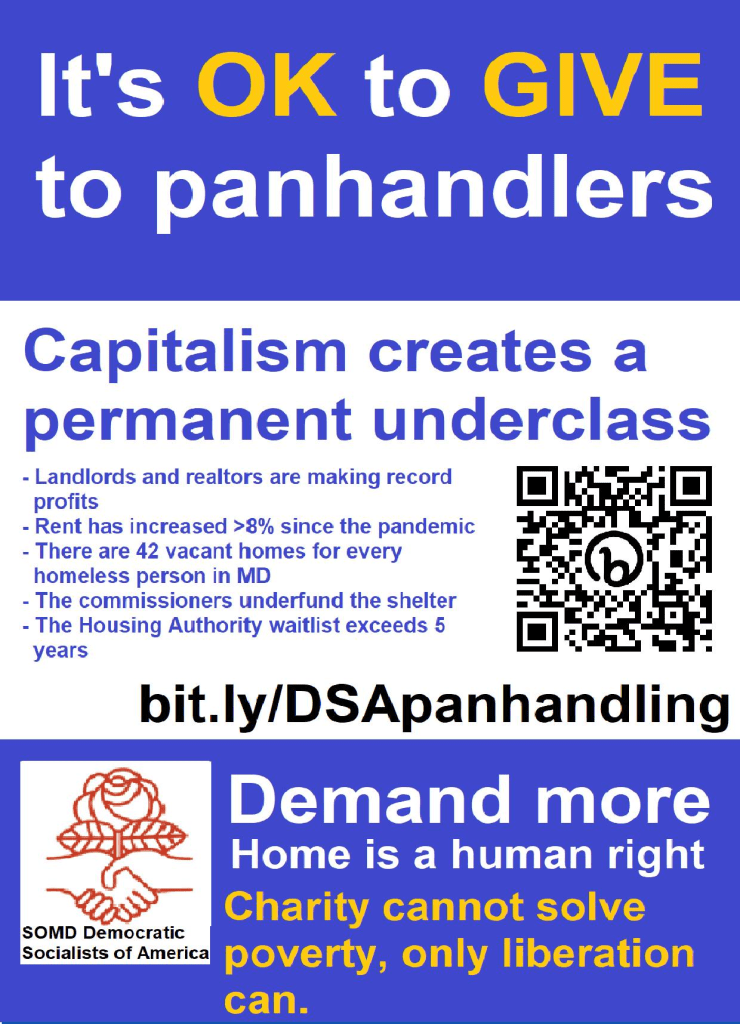
 Southern Maryland DSA