The text below is from a pamphlet titled “Who Is Pulling the Strings: Frequently Asked Questions about Capitalism.” It was written by our chapter as an accessible overview of the socialist critique of Capitalism. It is by no means an exhaustive critique – it is just an introduction in layman’s terms.
Table of Contents (clickable links coming soon):
- Introduction
- What is Capitalism?
- How does Capitalism exploit us?
- How does Capitalism create class inequality?
- What is the Alternative?
- Other Frequently Asked Questions
- What if I don’t have a job?
- What if I take pride in my work?
- Doesn’t raising wages cause unemployment?
- What about inflation?
- Can’t I become a capitalist if I work hard enough?
- Don’t capitalists take all the risks?
- Doesn’t Capitalism bring innovation?
- Don’t capitalists create jobs?
- Doesn’t Capitalism create growth?
- How does race fit into all of this?
- Now what?
Introduction
These days there is all sorts of talk about the “elite” running society and exploiting us all. Some people blame shadowy organizations within the “deep state.” Others concoct wilder, more convoluted theories.
And this is only natural. After all, most people can see we’re getting fucked. Most people can feel the effects of the constant degradation that all the working class and poor folks experience and see that – no matter who we vote into power – the government always seems to work against us. The problem is that many of the theories people believe divide us along the wrong lines and blame people who are in the same boat as the rest of us.
These theories are only a distraction from the real problem: our entire economic system is based on exploitation. The entire thing is set up to exploit the vast majority of us for the profit of a few individuals. White, black, trans, cis, straight, gay, Christian, pagan, atheist, Muslim, citizen, undocumented, etc – unless you’re a business owner, landlord, or trust-fund baby, you’re being exploited for the benefit of a few wealthy people.
This is why there is so much inequality and homelessness. This is why so few people can afford healthcare. Capitalism is a system based on making profit, and all profit comes from exploiting workers. So if you have to sell your labor to survive, then you’re being exploited.
As Americans, we’re taught to roll our eyes any time someone criticizes capitalism. We’re taught that anyone who criticizes capitalism must be some jealous naive child.
In reality, the critiques against capitalism are based on a deep analysis of its structure. By analyzing capitalism’s structure, you find out how it is based on exploitation, and why it leads to so much inequality and injustice.
By having a good analysis of capitalism, we can be aware of who is really pulling the strings. More importantly, though, we can be more effective in improving society. We can transform our lives more strategically.
What is Capitalism?
Often, when people talk about capitalism, they talk about markets: buying and selling goods and services. This oversimplifies things. Humans had markets for thousands of years before capitalism existed [1]. We’ve had markets as long as we’ve had civilization, but capitalism is only a couple of centuries old.
Capitalism is a Mode of Production. This means it is a specific kind of relationship between people and the way goods are produced. The tools we use to create goods are called Means of Production. Things like factory machines, tools, mines, and farms, are means of production because people use them to create food and products.
The capitalist mode of production is when the means of production are privately owned by individuals called capitalists[2]. They are called “capitalists” because they have capital. Capital is the wealth they use to buy means of production. They used those means of production to make profit.
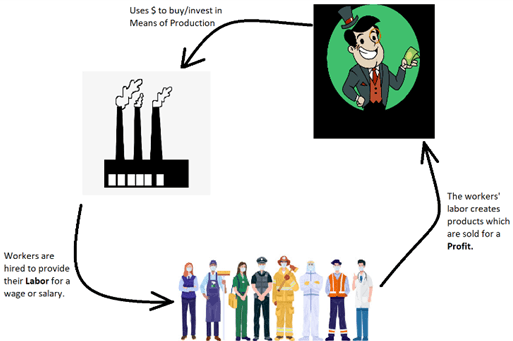
Now, obviously, the Means of Production do not make products by themselves! And the Capitalist very rarely works with the machines himself! This is why he must hire workers. The Means of Production are useless by themselves because Labor is needed to use them and produce things. Someone needs to work the machines, build things with the tools, and farm the land. Without labor, the means of production would sit and rot.
This relationship between Capitalists, Workers, and Means of Production, is the Capitalist Mode of Production. The capitalist has capital. He uses that capital to buy Means of Production. He hires workers to use the means of production to create products. He then sells those products for a profit.
It doesn’t matter how high taxes are, or whether or not there are free markets. As long as Capitalists privately own the means of production, it is capitalism.
This system may look good on paper. After all, who wouldn’t want to make their money work for them? Who doesn’t want to build wealth? The problem is that all of the capitalists’ wealth comes from exploiting the workers, and it creates an extremely unequal system.
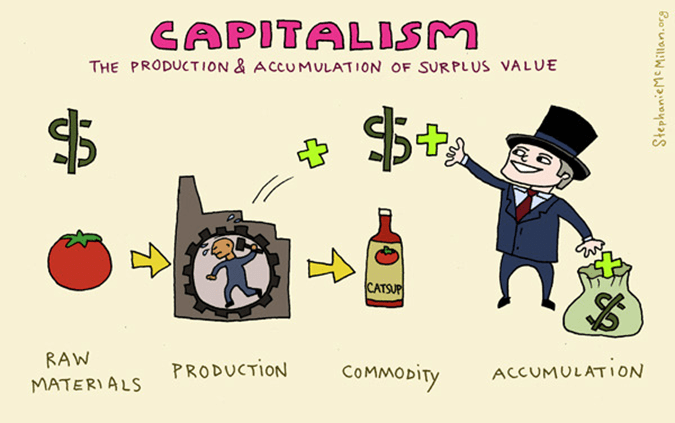
How does capitalism exploit us?
People like to say that the rich earned the right to own the means of production. After all, didn’t they work hard to earn that capital?
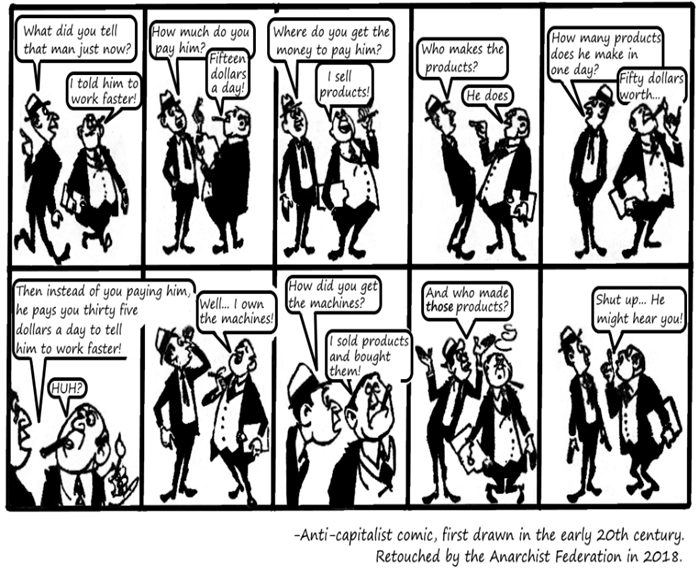
The short answer is no, they didn’t; you earned it for them. All of the profit that the capitalists make comes from something called Surplus Value. Surplus Value is a word for all of the money that’s left over after parts, maintenance, and labor.
I used to make a living cooking brick oven pizza, and I think it makes for a good example. I was the worker. I sold my labor by putting time and effort into making pizzas. The brick oven I used was the Means of Production. My boss owned the brick oven, therefore he owned the Means of Production.
I could make an 18 inch cheese pizza in about 7 minutes. I tossed the dough, put on the toppings, and masterfully cooked it by an open flame.
Each cheese pizza cost $11. The dough and toppings cost about $5. It costs about $1 in gas to keep the oven burning for the cooking time. I made $9.00 per hour, so in 7 minutes I made just about a dollar.
Take the $11 made from selling the pizza. Subtract $5 for materials, and $1 for the gas. You’re left with $5. Subtract the $1 I made during that time, and you have $4 of Surplus Value that goes to my boss.
It’s very important that you notice my boss made four times as much as me. I did say that we workers earn our bosses’ money for them, didn’t I?
Let’s look at that pizza’s value again: Without my labor, my boss would just have a brick oven, $5 worth of ingredients and a dollar worth of hot gas. But I took that $6 worth of ingredients and hot gas and I turned it into an $11 Pizza. This means that I added $5 of value with my labor. My labor was worth $5. But I only received $1.
My boss made his $4 of profit by paying me less than what my labor was worth. He gets to keep this Surplus Value because he owns the Means of Production.
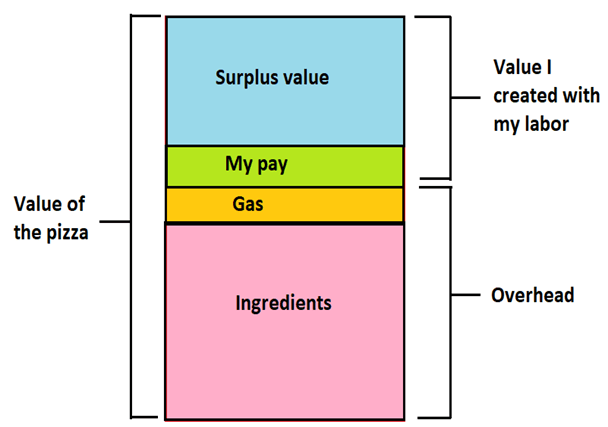
Surplus value is where all profit comes from. All profit comes from paying workers less than what their labor is worth. It doesn’t matter what you do, how many people you work with, or how small your boss’ business is. It doesn’t matter what the overhead costs are. If your boss is making a profit, then you are making less than your labor is worth. I simplified matters to show you the concept, but the fact remains that if I weren’t generating surplus value by earning less than I produced, I would not have stayed employed!
Take a worker at McDonalds. A lot of people like to say that McDonald’s workers shouldn’t be paid very much because their work is easy (wrong!) and doesn’t require much knowledge (also wrong!). But look at how profitable McDonald’s is: they made 4.73 billion dollars worth of profit in 2020[3]. All of that money is value the workers created! And yet those workers are only making minimum wage.
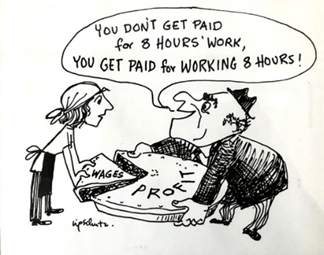
Even higher paid workers, like engineers on a military base, are being exploited. It may not seem like it, but companies like Boeing and Northrop Grumman couldn’t make billions of dollars of profit each year if they were not paying their workers less than their labor is worth.
Adam Smith called this way of calculating profit the Labor Theory of Value (LTV). There are a lot of factors that go into a product’s price, including supply and demand. The fact remains that profit has to come from somewhere, and the LTV shows us that profit always comes from paying workers less than they deserve.
This creates a divide between people who own capital, and people who sell their labor to make a living. Most everyone falls into one of these two classes.
How does capitalism create class inequality?
Under capitalism, you have to sell things on the market in order to make the money you need to survive. Capitalists have capital, so they can sell that capital, or use it to buy means of production to make more capital. Most of the rest of us do not have capital to sell. So in order to survive, we sell our bodies and our time by working.
This means that ultimately, there are really only two classes:
- The Capitalists: people who make their money by owning means of production – also called the Bourgeoisie (pronounced “boo zhwah zee”)
- The Workers: people who sell their labor for a wage or a salary – also called the Proletariat
The middle class, the working poor, the unemployed – we’re all workers, because we all have to sell our labor to survive. If you work for a wage and you have a boss, you are a worker. Engineers and line cooks have more in common with each other than they do with their bosses.
Whenever we talk about this, someone accuses us of “dividing people by wealth” (it’s funny that many of the same people are more than happy to divide us by sexuality or religion!), but this division is created because we have completely different interests. The capitalist Mode of Production puts us in a situation where the capitalists benefit when we suffer. Because of this, when we make more money, they make less profit. It is not a conflict based on jealousy or hatred. It’s a conflict based on completely opposing interests. I’m not “sewing division when I say this,” I’m pointing out a division that already exists!
Let’s look back at my pizza example. If I joined a union, and my salary went up, that would be good for me. I could afford to pay my rent and pay for groceries more easily. This, however, would be bad for my boss. There would be less Surplus Value for him to take, and so he’d make less profit. What is good for me, is bad for him.
In this situation, my boss could keep his profit by simply raising the price of each pizza. But this would hurt the consumers, who are also mostly workers, because now they must pay a higher price for pizza. What is good for him, is bad for us.
This is why the bourgeoisie are so hellbent on promoting racism, homophobia, xenophobia, etc. It’s because they want you focused on divisions that don’t matter so you don’t notice the only division that does matter! It’s because they don’t want you to realize that all of the working class share the same interests.
This conflict is also why the rich and the government always seem to be doing things that hurt us. If we have a higher minimum wage, they can’t make as much profit. If we have free healthcare, they can’t profit off of the medical industry. If we have affordable housing, they can’t profit off of high rent.
Take unemployment, for instance. It would be good for us workers if everyone could get a job, but it would be bad for capitalists. Right now, if we ask for a raise or unionize, our boss could always just hire somebody else. Having a lot of unemployed people gives them options. As long as there’s unemployment, there’s always someone willing to work for less. And they can always tell us we’re “lucky” to be employed.
This also gives them power over us. If they own the means of production at our job, they get to boss us around or fire us. If they own our homes, they can evict us whenever they want. They invest billions to influence politicians and pass laws that benefit them and hurt us. [12]
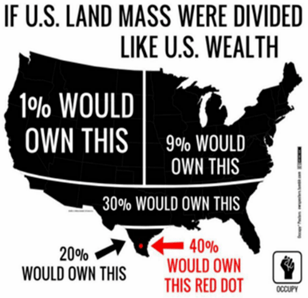
All of these things create income inequality on a massive scale. The world’s richest 1% own more than twice as much wealth as 6.9 billion people. The top 10% in the US own more than half of all of the country’s wealth. [4] All of that wealth comes from Surplus Value. It comes from exploiting workers by paying them less than what their labor is worth.
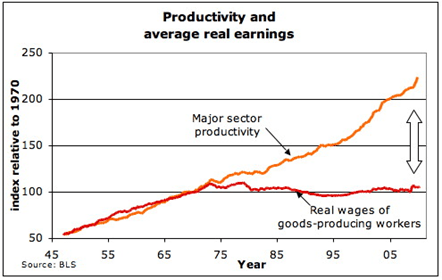
This inequality has gotten worse over time because the capitalists keep taking more and more surplus value. Since the 1970s, workers have increased productivity significantly. Adjusted for inflation however, our wages have stayed the same. Our labor causes the pie to get bigger, but we don’t get a share in that growth!
What is the alternative?
Because the capitalists control the means of production, they control our lives. We exist in society only for their profit – we can only eat if it profits Mondelez and Kraft-Heinz. We can only have shelter if it profits a landlord or a bank. We can only work to earn money if it profits our boss. If they could steal all the oxygen in the world and sell it back to us, they would.
Our “democracy” works for the capitalists as well. The politicians we elect come from the same class that uses their money to influence policy. Under capitalism, the state cannot truly represent the people because, under capitalism, the state is just the bouncer who makes sure the house always wins. Even the so-called “progressives” in government, who call for reforms and regulations, only want to make capitalism a little easier for people so they won’t tear the whole thing down.
But what if working people, together, controlled the means of production, instead of individual capitalists? If this were the case, we could produce food and shelter to help people survive instead of producing it to make someone rich. We could benefit from the full product of our labor instead of being exploited. We could make sure everyone gets a say, and everyone gets what they need.
When the workers take control over the means of production, this is called Socialism. We in the Southern Maryland Democratic Socialists of America believe Socialism represents true democracy. Capitalism ensures that our bosses and landlords have dictatorial control over our lives, and it ensures that politicians always represent the owning class. Democratic Socialism means giving the people democratic control over not only their government, but their workplace, and the resources they need to survive.
Democratic Socialism takes the power away from the owning class and gives it to the people.
This starts with building organizational power for the proletariat in our community. We must have strong networks for feeding and housing people, for community self-defense, and for workers and tenants to stand together. This is why we focus on supporting local mutual aid networks like Feed the People, supporting unions like the Charles County Bus Drivers and Attendants Association and the Teamsters in the UPS, and organizing tenants’ unions.
Building power for working class means building the power we need to liberate ourselves from exploitation and take control of a true democracy.
Other Frequently Asked Questions
Am I exploited if I don’t have a job?
You’re being exploited by how capitalists devalue you and use you as leverage.
Capitalist economists define any time not spent at a job as “leisure.” They see everything you do other than work for a capitalist as being essentially useless – even things like taking care of kids and elderly relatives, or growing your own food. No matter how worthwhile something is, unless you are generating a profit for a capitalist, it is called “leisure.”
This means that your value as a human being, under capitalism, is defined by how much profit you make for capitalists. Those who do not, or cannot, work for a capitalist are deemed worthless.
You know those people who say the unemployed shouldn’t get any help buying food or housing? Those people who say nasty things about the homeless? Those folks who act like taking care of kids and elderly relatives isn’t “real work?” They have been taught, by capitalist Dominant Ideology, that people who don’t generate profit at a job don’t deserve to live.
It goes beyond that. If we make sure that unemployed people can still live a dignified life, this hurts the capitalists. First, because they might have to pay more in taxes. Second, because capitalists need unemployed people to be miserable.
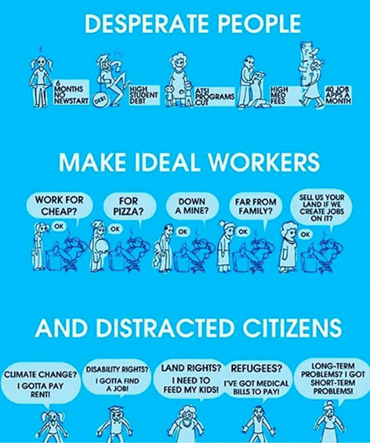
Take what happened in the Spring and Summer of 2021. Restaurants and stores were severely understaffed. Business owners blamed the COVID 19 unemployment checks. Since people were getting by okay on unemployment, they weren’t willing to work for poverty wages. They weren’t willing to deal with abusive customers and managers. Instead, they were trying to get better paying, more fulfilling jobs. Restaurants and stores had to raise their wages and increase benefits.
When being unemployed means being in misery and poverty, it is easier for capitalists to exploit their workers. When unemployed people can live with dignity, it is harder for capitalists to exploit their workers.
I worked at a restaurant right after the 2008 financial crisis. The unemployment rate was 9.5%. Any time someone asked for a raise, or for a schedule change, our boss would tell us “there are plenty of people who would kill for your job and wouldn’t complain.” Having this Reserve Army of Labor gave them leverage over us.
In short, if you are unemployed, you are being exploited because capitalists keep you in poverty so they can use you as leverage.
What if I take pride in my work?
That’s great! But you’re still being exploited. Believe it or not, I actually liked making brick oven pizzas. I liked using my skill to make food that people enjoy. I liked honing my skills to make better and better pizzas. That doesn’t change the fact that I was making far less than my labor was worth. I was still struggling.
But there’s also the concept of alienation. Before capitalism, people made things and sold them themselves on a small scale. It was their trade. Let’s say I made chairs. I learned how to make chairs as a teenager, and perfected my craft to make the best chairs I could make. Each chair I made was my own. It was full of my passion and experience and I sold it myself to anyone who wanted to pay for it. Many people can still do this – they might make crafts and sell them on Etsy, or write a book or a song and make royalties. Those people aren’t capitalists, since they aren’t using capital to exploit other peoples’ labor.
Under capitalism, however most of us don’t own the things we make. We might make the chairs, as workers, but they belong to our boss, who sells them for a profit. In this way, We are alienated from our work. We can’t take as much pride in it, and we can’t make the full value of it.
We might be even more alienated because we no longer make the whole chair. Instead, we are parts of an assembly line. I attach one leg, and then pass it on to you to attach another. Now, we can no longer take pride in that chair at all. We are no longer making something with our own skill and passion.
There are plenty of people who find meaning in creating things with their work, but because of the capitalist Mode of Production, very few get to enjoy that meaning on their own terms.
The fact is, if we weren’t trying to survive, we’d probably all still be doing some kind of work. We’d just be doing the work that we find meaningful instead of the work that is profitable to capitalists.
Wouldn’t raising peoples’ wages cause unemployment?
There are two answers to this question, but let’s break down why people say this, first. They say that, if you raise wages, the capitalists will just raise prices to make up for it. Or the capitalists will fire workers so they can save money.
This idea makes sense on paper, but it doesn’t always happen, and when it does, it never happens the way capitalists say it will [5]. Think for a second what you would do if you got a raise. You’d spend that extra money on something, right? If a bunch of people got a raise, they would all have something they’d want to spend it on. This creates demand. This means more people will be able to buy the things that capitalists are selling. In order to meet that demand, capitalists will probably need more workers. If they fired workers, they wouldn’t be able to keep up with the demand. This is why raising the minimum wage rarely has a huge effect on unemployment. Therefore, the first answer is no.
The second answer is “that’s the point.” Anytime anyone says workers should make more money, someone says that it will have negative effects for the workers. If the capitalists fire people it just shows how their interests are the opposite of our own. It just shows that, under capitalism, the workers always lose. It’s not the workers’ fault; it’s the system’s fault. Capitalism was built to benefit the capitalists, not us.
The reality is that capitalism can’t produce better conditions for workers, because it’s based on exploiting workers. The only way to really make sure people make what they deserve is to end capitalism.
What about inflation?
Inflation generally refers to prices rising, and it hits the working class and poor really hard. Sincce 2022, we’ve seen a lot of inflation in food and fuel prices. Capitalists like to blame inflation on workers. They claim that increasing wages is the cause of inflation and we need to keep certain people’s wages low in order to keep prices low.
There are a few problems with this. First, it’s not necessarily true. In 2022 the companies that raised their prices the most also saw record profits[16]. How can this be if they’re struggling to pay workers? The truth is that they’re using inflation as an excuse to increase their profits at your expense. Additionally, increasing wages can also save companies money on training because fewer people are quitting for better jobs.
Second, this just proves that capitalism can’tproduce better conditions for workers (see: unemployment). When workers get a bigger slice of the pie, the capitalists just make the pie bigger so their slice stays the same size. They can do this because the capitalist mode of production gives them power. It doesn’t make sense to blame the worker for the bosses’ greed. But they want us blaming other workers for our problems instead of them. It’s a divide and conquer tactic!
And that brings me to the third problem. When people blame workers wages for rising prices (or unemployment), what they’re saying is they think certain people should be poor so we can pay low prices. They are saying we should have a permanent underclass of impoverished workers to keep the system running. They are admitting that capitalism needs to keep people poor and exploited!
Can’t I become a capitalist if I work hard enough?
In America, capitalists have sold us the idea of the American Dream. We hear all about the people who started with nothing and became rich, and we’re taught to firmly believe that we can do it too. As John Steinbeck said, Americans tend to see themselves “as temporarily embarrassed millionaires.”
First, most of the “self-made” billionaires had huge advantages. For example, Jeff Bezos famously started Amazon in a garage, but his parents were able to invest $245,573 in his company to help him get started [13]. Bill Gates’ mother was the chair of United Way and used her position to help Microsoft get a contract with IBM [14].
The fact is that it’s extremely rare for someone to get rich without already having financial privilege. Most wealth is inherited.[15] Most of the people who become rich inherited some wealth, or advantages, from their parents. Parents who are in poverty, or disadvantaged, unfortunately pass that on to their kids.
It’s also getting harder to rise out of poverty. The National Academy of Sciences found that, over the last 150 years, it has become harder and harder for people from poor backgrounds to rise to a higher status than their parents [6].
So what’s keeping people from “pulling themselves up by their bootstraps?” The Urban Institute identified several things that prevent people from poor communities from rising up [7]. Here are just a few:
- Lack of access to early childhood education
- Lack of access to career training and/or college
- Unintended pregnancies (lack of access to birth control and abortion)
- High rates of incarceration and policing
Each and every one of those things affects poor people more than wealthy people. Wealthy people can pay for daycare and college. They have medical insurance that covers birth control. They live in communities that aren’t overpoliced.
This is another example of capitalists and workers having opposing interests. Our government could fix each of those things easily, but it won’t, because it would hurt capitalist profits. Businesses might have to pay higher taxes to cover free college or healthcare. Private prison corporations make billions each year from mass incarceration.
But it’s more than that. Capitalism needs a lower class. They don’t want us to climb the ladder. If everyone has the opportunity to improve their status, nobody will be desperate enough to work for poverty wages. Nobody will be desperate enough to live in a slum. It’s harder to exploit people who aren’t desperate. Not only that, but the capitalists do not want you to identify with your fellow workers. If you look down on people who are struggling – if you believe that low-wage workers simply don’t deserve more because they haven’t earned it – then you’re less likely to unite with them, and more likely to support policies that hurt workers like yourself.
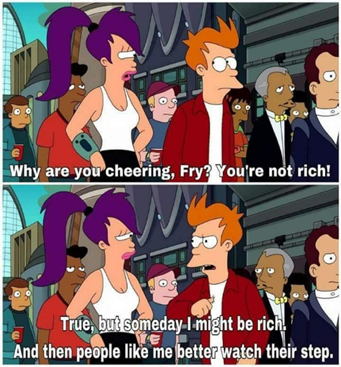
Don’t capitalists take all of the risks?
People say capitalists deserve to profit because they took a risk by creating a business. If the business fails, they are the ones who lose money. This does not disprove the fact that their profit comes from surplus value. It just proves that people think they deserve to take workers’ surplus value.
What this argument comes down to is entitlement. The people who say this believe that capitalists are entitled to profits at the expense of workers. Let’s take the minimum wage for example. People who oppose increasing the minimum wage say that capitalists cannot profit if they pay their workers more. But why are capitalists entitled to profit, when workers aren’t entitled to a better wage?
Wasn’t losing profits the risk you say the capitalist took? It’s funny how the capitalist supposedly takes all of the risk, but it’s the workers who have to accept poverty wages so the capitalist can profit. It’s the workers who get their hours cut, or get laid off, when capitalists aren’t making enough profit. If a capitalist loses profit and cannot compete in the market, we are the first ones to lose!
Let’s take a look at what, specifically, is at risk. If a capitalist’s business fails, they lose their business and go back to being a worker. They have to get a job. When workers get a major pay cut, or get laid off, they lose their homes and ability to put food on the table. We’re not risking the same thing.
The idea that capitalists take all the risks is a distraction. What they’re really trying to say is that capitalists, just for being capitalists, deserve to profit no matter how much it hurts workers.
So the real question is: “why is it that capitalists are entitled to have a profitable business, but workers aren’t entitled to the full value of their labor?” The answer is that the Capitalist mode of production puts the capitalist in power. That’s the only reason.
Doesn’t capitalism bring innovation?
This is a popular defense of capitalism. After all, we have had huge technological advancements under capitalism. We went from the steam engine to the iPhone in just a couple of hundred years.
But capitalism didn’t do that. Workers did. Workers designed those things, workers built them, and workers came up with ways to improve them. Jeff Bezos doesn’t get your Prime orders to your house in 2 days; an army of workers does. He didn’t figure out how to get your orders to you in two days. Engineers who work for him did that.
Necessity is the mother of invention. Human beings innovate so they can solve problems. We invented the wheel and farming, thousands of years before capitalism, because we needed food and transportation. Even under capitalism, people invent things all the time just to solve problems. When Jonas Salk invented the Polio Vaccine, he insisted that it not be patented [8]. He invented the vaccine to cure people, not to profit.
Now here’s where things get complicated. Capitalism is good at encouraging innovation – it’s just not always innovation that helps people. They invent all sorts of clever new ways to get more surplus value. They invent machines that replace workers (like self-checkout machines and AI generated art). They also invent machines that alienate workers from their labor even more (see: what if I take pride in my work?). Innovation should mean that our lives get easier, but under capitalism, it just means we get exploited more efficiently.
Don’t capitalists create jobs?
No. Demand creates jobs. Capitalists hire more people because demand for their products is high, and they need to meet that demand. If there were no capitalist mode of production, people would still need things. They’d still demand things, so there’d still be work for people to do. They’d just do it with a different mode of production.
People did work to meet their needs under feudalism, under agrarianism, and in hunter-gatherer societies. They will continue to do it when we have outgrown capitalism. The fact is, the same way necessity is the mother of invention, it is also the mother of work. If people need toilets, people are going to work to build toilets, with or without capitalism.
In fact, sometimes the capitalist mode of production can limit the work we can get. Look around you. Our bridges are crumbling. Our rivers need to be cleaned. This is work we need someone to do, but there aren’t very many people doing it, because it is not profitable for capitalists.
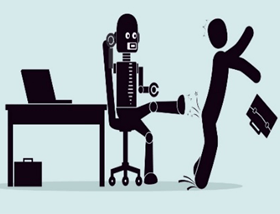
In this way, capitalism is actively not creating jobs to do the things society needs (See also: “wouldn’t raising peoples’ wages cause unemployment” and “doesn’t capitalism create innovation?”).
Doesn’t capitalism create growth?
Yes, it does. Capitalism is good at creating growth. Companies take the surplus value that comes from exploiting workers, and use it to make their companies bigger. That’s actually where all growth comes from – it comes from the money we’re not being paid for our labor.
America industrialized through machines that made clothing, which was made from cheap cotton from the south. Cotton from the south was cheap because of slave labor. The surplus value made from slavery enabled the growth of industry [9].
Some of the problems in communist countries come from this. They had a revolution before they industrialized, so they had to figure out how to industrialize without capitalism[10]. It was a huge challenge.
Karl Marx himself admitted that exploitation is needed to for large-scale growth. But he thought that, after growth reached a certain point, the workers should take control and use it to help everyone.
Even still, growth isn’t always a good thing. In order for capitalists to keep profiting, they have to keep growing. They have to acquire more resources and sell to larger amounts of people. This creates an incentive to colonize other places. The United States often goes to war with countries that have oil so the oil economy can grow. This is why Great Britain’s empire was its largest during industrialization [11]. Their companies needed to exploit more people and more resources from other countries in order to keep growing.
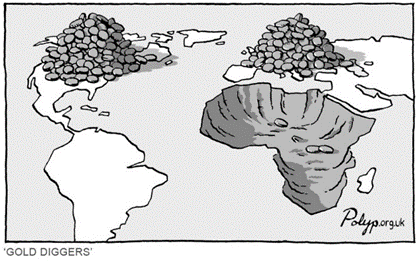
We’ve had tremendous growth under capitalism, but we hardly ever see any of it! We produce more than enough food to feed everyone. We produce more than enough homes to house everyone. Growth is mostly for the benefit of the capitalists. When it benefits us we’re getting scraps. If the capitalist class weren’t exploiting our labor and amassing ludicrous fortunes, would we even still need all this growth?
Does Race fit into all of this?
Race was invented to divide the working class. During the early days of colonization, Europeans under indentured servitude weren’t treated much better than enslaved Africans. They often intermarried with enslaved people, or they ran off to join the American Indians. The planter class (who would become the capitalists) saw this as a threat to their power, so they started treating European indentured servants better, and giving them a position of power over enslaved people. One of the first uses of the word “white” to refer to race was in a law forbidding European indentured servants from marrying enslaved people. They invented our concept of “whiteness” so that European workers would identify with the ones exploiting them, instead of the people who were also being exploited. White people who continue to see black and indigenous people as an “other” are just continuing a long tradition of being duped into dividing the working class on behalf of the elite. This is why socialists are often dedicated to racial justice, and why so many prominent Civil Rights leaders were socialists.
Okay, now what?
The most important thing for the working class to do is to organize. When we organize together, we are stronger than the capitalists. Alone, you can only advocate for yourself so much. United, we can bargain for better pay and benefits, and start taking the political power we need to build a better world. United we bargain, divided we beg.
This is why Labor Unions are so important. If your workplace has a union, join it. And if it is not unionized, contact a union that works in your industry and try to start one! Make sure to support all strikes: don’t buy products from companies whose workers are striking, and don’t take jobs from striking workers.
Unions can only do so much on their own, however. We need socialist organizations to fight for transformation of the entire system, and full liberation from exploitation. The Southern Maryland Democratic Socialists of America is the only explicitly socialist organization in St. Mary’s and Calvert Counties.
Finally, and most importantly, talk to fellow working class people! Talk to them about exploitation, and about why we’re living in these conditions. Talk about what you can do in your community, and tell them that there is another way. We have nothing to lose but our chains!

Glossary of terms used in this booklet
- Alienation – when the things you create with your labor don’t belong to you, and you can no longer feel as much pride in them.
- Bourgeoisie – see “Capitalist.”
- Capital – wealth used to invest in things, like for buying Means of Production.
- Capitalism – a system where the Means of Production are owned privately by capitalists, and use to make profit.
- Capitalist – a person who makes money from owning Means of Production
- Demand – how much people desire to buy a product
- Dominant Ideology – the set of beliefs that uphold the current system.
- Labor – the work necessary to create products. All workers under capitalism sell their labor to their boss for a wage.
- Means of Production – the machines, fields, and tools used to create the products people need.
- Mode of Production – The kind of relationship there is between people and the Means of Production.
- Profit – the amount of money a capitalist takes after materials and labor are paid for. It comes from Surplus Value.
- Proletariat – the class made up of everyone who survives by selling their labor for a wage.
- Reserve Army of Labor – the population of unemployed people that capitalists use to keep wages down.
- Socialism – a system where the working class of society take control of the means of production and the state in order for both to be controlled democratically, for the benefit of all.
- Solidarity – realizing you have the same interests as someone else and having their back.
- Surplus Value – what is left when you subtract a worker’s wages from the value that worker created with their labor. Unpaid labor.
- Wages – how much a worker makes by selling their labor and time to a capitalist.
Want to Learn More? Check out our recommended reading/listening list!
References
- https://www.worldhistory.org/article/149/herodotus-on-the-customs-of-the-persians/
- https://www.merriam-webster.com/dictionary/capitalism
- https://bit.ly/2Ukswmb
- https://www.oxfam.org/en/5-shocking-facts-about-extreme-global-inequality-and-how-even-it
- https://www.cbo.gov/system/files/2019-07/CBO-55410-MinimumWage2019.pdf
- https://www.pnas.org/content/117/1/251
- https://www.urban.org/urban-wire/how-philanthropy-can-address-barriers-social-mobility
- https://www.salk.edu/about/history-of-salk/jonas-salk/
- https://www.jstor.org/stable/3744401
- https://www.jstor.org/stable/1520423
- https://link.springer.com/chapter/10.1007/978-3-030-47368-6_2
- https://www.forbes.com/sites/michelatindera/2021/02/25/these-billionaire-donors-spent-the-most-money-on-the-2020-election/?sh=7985aa2014ce
- https://www.insider.com/jeff-bezos-parents-jackie-mike-amazon-investment-worth-2018-7?render-embed=video y
- https://www.cnbc.com/2020/08/05/how-bill-gates-mother-influenced-the-success-of-microsoft.html
- https://www.washingtonpost.com/us-policy/2019/02/06/people-like-estate-tax-whole-lot-more-when-they-learn-how-wealth-is-distributed/
- https://www.marketwatch.com/story/corporate-profit-is-at-a-level-well-beyond-what-we-have-ever-seen-and-its-expected-to-keep-growing-11649802739
Image Credits:
- Image 1: https://stephaniemcmillan.org/
- Image 2: www.socialistworker.org
- Image 3: https://youngoctobers.quora.com/The-Information-War
- Image 4: https://climateandcapitalism.com/
- Image 5: https://researchgate.net/
- Image 6: https://www.polyp.org.uk/
 Southern Maryland DSA